What Kindness Does to Your Brain | Micro-Habits That Rewire Leadership
You are three hours into back-to-back meetings, the third escalation email of the day just arrived, and someone on your team missed a deadline again. Your jaw tightens. Your breath shortens. The voice in your head says: Be firm. Hold the line. Show strength. And in that moment, kindness feels like a luxury you cannot afford.
Except your nervous system knows something your urgency does not. When you choose harshness over compassion—even in small, everyday moments—you activate your sympathetic stress response, narrow your cognitive flexibility, and send ripple effects of cortisol and defensiveness through everyone around you. Your brain interprets urgency as threat, and threat mode makes you a less effective leader, not a stronger one.
Subscribe to my Newsletter: https://www.linkedin.com/pulse/human-cost-hard-leadership-eva-selhub-md-qjmhe

Kindness is not the soft alternative to strong leadership. Kindness is the biological pathway to resilience, clear thinking, and sustainable performance. When you lead with genuine compassion, you engage your vagus nerve—the primary parasympathetic pathway that governs emotional regulation, social connection, and recovery from stress. You shift your brain from survival mode to integration mode. You model the very nervous system state your team needs to perform under pressure without breaking down. (https://www.drselhub.com/how-to-build-unshakeable-resilience-in-leadership-a-mid-year-guide-for-2025)
The vagus nerve functions like a biological superhighway between your brain and your body, carrying signals that regulate heart rate, digestion, immune response, and emotional tone. High vagal tone correlates with better stress resilience, faster recovery from setbacks, stronger social bonds, and more adaptive decision-making. Leaders who practice compassion—toward themselves and others—literally strengthen this pathway, creating a physiological foundation for both personal wellbeing and organizational effectiveness.
What Kindness Does to Your Brain
Compassionate action activates specific neural networks that hardness shuts down. When you respond to difficulty with empathy rather than judgment, your anterior cingulate cortex and insula engage—regions involved in emotional awareness and perspective-taking. Your prefrontal cortex maintains executive function instead of handing control to your amygdala. Blood flow supports integration and problem-solving rather than reactive defensiveness. (https://www.drselhub.com/the-mind-body-science-behind-leadership-excellence/)
Practicing loving-kindness meditation and compassion-focused interventions increase activity in brain areas associated with empathy, positive emotion, and reward processing. Over time, these practices thicken cortical regions linked to emotional regulation and reduce amygdala reactivity to stress. You are not just feeling different in the moment—you are reshaping the architecture your brain uses to interpret challenges and respond to others.
The vagus nerve responds directly to your emotional stance. When you approach interactions with warmth, curiosity, and genuine care, vagal activity increases. Heart rate variability improves, signaling greater nervous system flexibility. This physiological shift allows you to remain present during conflict, hear feedback without collapsing into defensiveness, and make decisions that account for both immediate demands and long-term relationships. Kindness creates the internal conditions for wisdom.
Research on compassion training in workplace and clinical settings demonstrates measurable outcomes. Participants show reduced burnout, lower anxiety and depression symptoms, improved job satisfaction, and stronger interpersonal connection. Leaders who receive compassion-focused coaching report feeling more resilient, making clearer decisions under pressure, and creating teams with higher psychological safety. The effects extend beyond individual wellbeing to team performance, retention, and organizational culture.
Subscribe to my Newsletter: https://www.linkedin.com/pulse/human-cost-hard-leadership-eva-selhub-md-qjmhe
(Neff, K. D. (2011). Self-compassion, self-esteem, and well-being. Social and Personality Psychology Compass, 5(1), 1-12.
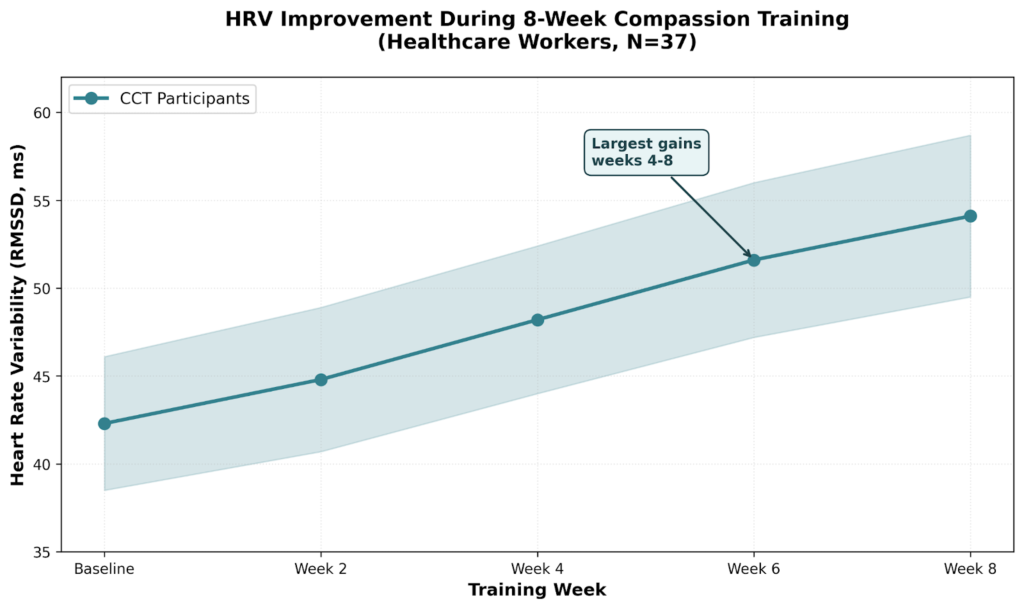
KEY STATS: The Business Case for Compassionate Leadership
- Burnout affects 76% of employees at least sometimes, with toxic leadership cultures identified as a primary driver. (https://www.forbes.com/sites/hennainam/2023/10/26/to-be-more-agile-be-coachable-four-ways-leaders-become-coachable/)
- Compassion training interventions (8–12 weeks) show significant improvements in stress biomarkers, including reduced cortisol and increased heart rate variability. ( https://www.ifit.com/blog/focus/ifit-guide-highlight-dr-eva-selhub)
- Healthcare workers receiving compassion training demonstrate 30–40% reductions in burnout and emotional exhaustion scores. (https://www.drselhub.com/why-emotional-intelligence-matters-more-than-iq-in-2025/)
- Leaders trained in empathy and emotional intelligence report 25–35% improvements in decision-making quality and team cohesion. (https://www.drselhub.com/blog/)
Your Daily Compassion Protocol: Five Micro-Habits That Rewire Leadership

These practices take less than ten minutes total. Consistency matters more than duration. Each micro-habit strengthens the vagal tone and trains your nervous system to default toward compassion under pressure.
1. Morning Self-Compassion Reset (2 minutes)
What to do: Before checking devices, sit comfortably, place both hands over your heart, and silently offer yourself kindness. Use phrases like: May I be kind to myself today. May I remember my humanity. May I meet challenges with patience.
Minimum effective dose: 90 seconds, at least 5 days per week.
When to use: First thing upon waking or immediately after the morning routine begins.
Common mistake to avoid: Rushing through words without feeling. Slow down. Let your nervous system register the warmth you are offering yourself.
2. Breath-Based Vagal Toning (3 minutes)
What to do: Extended-exhale breathing activates parasympathetic tone and strengthens vagal function. Inhale through your nose for 4 counts, exhale through your mouth for 6–8 counts. Repeat for 10–12 cycles.
Minimum effective dose: 3 minutes daily, or 90 seconds before high-stakes interactions.
When to use: Mid-morning energy dip, before difficult meetings, when you notice tension rising.
Common mistake to avoid: Forcing the breath. Find your natural rhythm and gradually extend the exhale without strain.
3. Gratitude Micro-Reflection (1 minute)
What to do: Identify one specific moment from the past 24 hours where someone showed you kindness, competence, or care. Replay it mentally with detail. Notice the warmth in your chest.
Minimum effective dose: 30–60 seconds daily.
When to use: During lunch break or transition between tasks.
Common mistake to avoid: Staying abstract. Instead of “I am grateful for my team,” recall: Sarah stayed late to help me prep that presentation. I felt supported. Specificity activates the neural reward circuits.
4. Compassionate Assumption Practice (ongoing)
What to do: When someone’s behavior frustrates you, pause and generate one compassionate explanation for their action. Maybe they are overwhelmed. Maybe they received hard news. Maybe they are doing their best with limited resources. You do not need to know if it is true—the practice shifts your nervous system out of judgment and into curiosity.
Minimum effective dose: Apply once per day to one frustrating moment.
When to use: Real-time, when irritation arises.
Common mistake to avoid: Using this to suppress legitimate boundaries. Compassionate assumption does not mean tolerating harmful behavior—it means approaching problems from regulation rather than reactivity.
5. End-of-Day Loving-Kindness Reflection (3 minutes)
What to do: Before sleep, silently extend kindness toward three people: yourself, someone you care about, someone you find difficult. Use phrases like: May [name] be safe. May [name] be healthy. May [name] live with ease. Notice resistance without judgment.
Minimum effective dose: 2 minutes, 4–5 nights per week.
When to use: Final moments before sleep or during evening wind-down.
Common mistake to avoid: Forcing warm feelings. The practice is the intention, not the emotional result. Even mechanical repetition rewires neural pathways over time
TRY THIS TODAY
Choose one micro-habit from the protocol above and practice it today. Notice what happens in your body, your thoughts, your interactions. You do not need to transform your entire leadership approach overnight. You need to take one small step toward the nervous system state that allows transformation to unfold. Start with two minutes of self-compassion. Start with one extended-exhale breath before your next meeting. Start with one compassionate assumption about someone who frustrates you. Start where you are. Your biology will meet you there.
Subscribe to my Newsletter: https://www.linkedin.com/pulse/human-cost-hard-leadership-eva-selhub-md-qjmhe
REFERENCES
McEwen, B. S., & Akil, H. (2020). Revisiting the stress concept: Implications for affective disorders. Journal of Neuroscience, 40(1), 12-21.
https://doi.org/10.1523/JNEUROSCI.0733-19.2019
Arnsten, A. F. (2009). Stress signalling pathways that impair prefrontal cortex structure and function. Nature Reviews Neuroscience, 10(6), 410-422.
https://doi.org/10.1038/nrn2648
Porges, S. W. (2011). The Polyvagal Theory: Neurophysiological Foundations of Emotions, Attachment, Communication, and Self-regulation. W.W. Norton & Company.
Kok, B. E., & Fredrickson, B. L. (2010). Upward spirals of the heart: Autonomic flexibility, as indexed by vagal tone, reciprocally and prospectively predicts positive emotions and social connectedness. Biological Psychology, 85(3), 432-436.
https://doi.org/10.1016/j.biopsycho.2010.09.005
Thayer, J. F., & Lane, R. D. (2009). Claude Bernard and the heart-brain connection: Further elaboration of a model of neurovisceral integration. Neuroscience & Biobehavioral Reviews, 33(2), 81-88.
https://doi.org/10.1016/j.neubiorev.2008.08.004
Kok, B. E., Coffey, K. A., Cohn, M. A., Catalino, L. I., Vacharkulksemsuk, T., Algoe, S. B., Brantley, M., & Fredrickson, B. L. (2013). How positive emotions build physical health: Perceived positive social connections account for the upward spiral between positive emotions and vagal tone. Psychological Science, 24(7), 1123-1132.
https://doi.org/10.1177/0956797612470827
Stellar, J. E., Cohen, A., Oveis, C., & Keltner, D. (2015). Affective and physiological responses to the suffering of others: Compassion and vagal activity. Journal of Personality and Social Psychology, 108(4), 572-585.
https://doi.org/10.1037/pspi0000010
Klimecki, O. M., Leiberg, S., Ricard, M., & Singer, T. (2014). Differential pattern of functional brain plasticity after compassion and empathy training. Social Cognitive and Affective Neuroscience, 9(6), 873-879.
https://doi.org/10.1093/scan/nst060
Goleman, D., & Boyatzis, R. (2008). Social intelligence and the biology of leadership. Harvard Business Review, 86(9), 74-81. PMID: 18777379
Weng, H. Y., Fox, A. S., Shackman, A. J., Stodola, D. E., Caldwell, J. Z., Olson, M. C., Rogers, G. M., & Davidson, R. J. (2013). Compassion training alters altruism and neural responses to suffering. Psychological Science, 24(7), 1171-1180.
https://doi.org/10.1177/0956797612469537
Lutz, A., Brefczynski-Lewis, J., Johnstone, T., & Davidson, R. J. (2008). Regulation of the neural circuitry of emotion by compassion meditation: Effects of meditative expertise. PLoS ONE, 3(3), e1897.
https://doi.org/10.1371/journal.pone.0001897
Gerritsen, R. J., & Band, G. P. (2018). Breath of life: The respiratory vagal stimulation model of contemplative activity. Frontiers in Human Neuroscience, 12, 397.
https://doi.org/10.3389/fnhum.2018.00397
Kirby, J. N., Tellegen, C. L., & Steindl, S. R. (2017). A meta-analysis of compassion-based interventions: Current state of knowledge and future directions. Behavior Therapy, 48(6), 778-792.
https://doi.org/10.1016/j.beth.2017.06.003
Scarlet, J., Altmeyer, N., Knier, S., & Harpin, R. E. (2017). The effects of Compassion Cultivation Training (CCT) on health-care workers. Clinical Psychologist, 21(2), 116-124.
https://doi.org/10.1111/cp.12130
Rynes, S. L., Bartunek, J. M., Dutton, J. E., & Margolis, J. D. (2012). Care and compassion through an organizational lens: Opening up new possibilities. Academy of Management Review, 37(4), 503-523.
https://doi.org/10.5465/amr.2012.0124
Dutton, J. E., Workman, K. M., & Hardin, A. E. (2014). Compassion at work. Annual Review of Organizational Psychology and Organizational Behavior, 1(1), 277-304.
https://doi.org/10.1146/annurev-orgpsych-031413-091221
Lilius, J. M., Worline, M. C., Maitlis, S., Kanov, J., Dutton, J. E., & Frost, P. (2008). The contours and consequences of compassion at work. Journal of Organizational Behavior, 29(2), 193-218.
https://doi.org/10.1002/job.508
Harter, J., & Adkins, A. (2015). Employees want a lot more from their managers. Gallup Business Journal. Retrieved from
https://www.gallup.com/workplace/236570/employees-lot-managers.aspx
Moss, J. (2021). Beyond burned out. Harvard Business Review, 99(1), 66-72.
Pace, T. W., Negi, L. T., Adame, D. D., Cole, S. P., Sivilli, T. I., Brown, T. D., Issa, M. J., & Raison, C. L. (2009). Effect of compassion meditation on neuroendocrine, innate immune and behavioral responses to psychosocial stress. Psychoneuroendocrinology, 34(1), 87-98.
https://doi.org/10.1016/j.psyneuen.2008.08.011
Edmondson, A. C., & Lei, Z. (2014). Psychological safety: The history, renaissance, and future of an interpersonal construct. Annual Review of Organizational Psychology and Organizational Behavior, 1(1), 23-43.
https://doi.org/10.1146/annurev-orgpsych-031413-091305
Orellana-Rios, C. L., Radbruch, L., Kern, M., Regel, Y. U., Anton, A., Sinclair, S., & Schmidt, S. (2018). Mindfulness and compassion-oriented practices at work reduce distress and enhance self-care of palliative care teams: A mixed-method evaluation of an “on the job” program. BMC Palliative Care, 17(1), 3.
https://doi.org/10.1186/s12904-017-0219-7
Goleman, D., Boyatzis, R., & McKee, A. (2013). Primal Leadership: Unleashing the Power of Emotional Intelligence. Harvard Business Press.
Caruso, D. R., & Salovey, P. (2004). The Emotionally Intelligent Manager: How to Develop and Use the Four Key Emotional Skills of Leadership. Jossey-Bass.
Neff, K. D. (2011). Self-compassion, self-esteem, and well-being. Social and Personality Psychology Compass, 5(1), 1-12.
https://doi.org/10.1111/j.1751-9004.2010.00330.x
Neff, K. D., & Germer, C. K. (2013). A pilot study and randomized controlled trial of the mindful self-compassion program. Journal of Clinical Psychology, 69(1), 28-44.
https://doi.org/10.1002/jclp.21923
Breines, J. G., & Chen, S. (2012). Self-compassion increases self-improvement motivation. Personality and Social Psychology Bulletin, 38(9), 1133-1143.
https://doi.org/10.1177/0146167212445599
Gilbert, P., & Procter, S. (2006). Compassionate mind training for people with high shame and self-criticism: Overview and pilot study of a group therapy approach. Clinical Psychology & Psychotherapy, 13(6), 353-379.
https://doi.org/10.1002/cpp.507
Neff, K. D., & Dahm, K. A. (2015). Self-compassion: What it is, what it does, and how it relates to mindfulness. In B. D. Ostafin, M. D. Robinson, & B. P. Meier (Eds.), Handbook of Mindfulness and Self-Regulation (pp. 121-137). Springer.
https://doi.org/10.1007/978-1-4939-2263-5_10
Kanov, J. M., Maitlis, S., Worline, M. C., Dutton, J. E., Frost, P. J., & Lilius, J. M. (2004). Compassion in organizational life. American Behavioral Scientist, 47(6), 808-827.
https://doi.org/10.1177/0002764203260211
Simpson, A. V., Farr-Wharton, B., & Reddy, P. (2020). Cultivating organizational compassion in healthcare. Journal of Management & Organization, 26(3), 340-354.
https://doi.org/10.1017/jmo.2019.54
Atkins, P. W., & Parker, S. K. (2012). Understanding individual compassion in organizations: The role of appraisals and psychological flexibility. Academy of Management Review, 37(4), 524-546.
https://doi.org/10.5465/amr.2010.0490
Decety, J., & Fotopoulou, A. (2015). Why empathy has a beneficial impact on others in medicine: Unifying theories. Frontiers in Behavioral Neuroscience, 8, 457.
https://doi.org/10.3389/fnbeh.2014.00457
Boyatzis, R. E., Smith, M. L., & Blaize, N. (2006). Developing sustainable leaders through coaching and compassion. Academy of Management Learning & Education, 5(1), 8-24.
https://doi.org/10.5465/amle.2006.20388381
Mayo Clinic. (2021). Stress management: Breathing exercises for relaxation. Retrieved from
https://www.mayoclinic.org/healthy-lifestyle/stress-management
Worline, M. C., & Dutton, J. E. (2017). Awakening Compassion at Work: The Quiet Power That Elevates People and Organizations. Berrett-Koehler Publishers.
Frazier, M. L., Fainshmidt, S., Klinger, R. L., Pezeshkan, A., & Vracheva, V. (2017). Psychological safety: A meta-analytic review and extension. Personnel Psychology, 70(1), 113-165.
https://doi.org/10.1111/peps.12183
Carmeli, A., & Gittell, J. H. (2009). High-quality relationships, psychological safety, and learning from failures in work organizations. Journal of Organizational Behavior, 30(6), 709-729.
https://doi.org/10.1002/job.565
Grant, A. M., Dutton, J. E., & Rosso, B. D. (2008). Giving commitment: Employee support programs and the prosocial sensemaking process. Academy of Management Journal, 51(5), 898-918.
https://doi.org/10.5465/amj.2008.34789652
Deci, E. L., & Ryan, R. M. (2008). Self-determination theory: A macrotheory of human motivation, development, and health. Canadian Psychology, 49(3), 182-185.
https://doi.org/10.1037/a0012801
Dutton, J. E., & Ragins, B. R. (Eds.). (2007). Exploring Positive Relationships at Work: Building a Theoretical and Research Foundation. Psychology Press.
Emmons, R. A., & McCullough, M. E. (2003). Counting blessings versus burdens: An experimental investigation of gratitude and subjective well-being in daily life. Journal of Personality and Social Psychology, 84(2), 377-389.
https://doi.org/10.1037/0022-3514.84.2.377
Wood, A. M., Froh, J. J., & Geraghty, A. W. (2010). Gratitude and well-being: A review and theoretical integration. Clinical Psychology Review, 30(7), 890-905.
https://doi.org/10.1016/j.cpr.2010.03.005
Strauss, C., Taylor, B. L., Gu, J., Kuyken, W., Baer, R., Jones, F., & Cavanagh, K. (2016). What is compassion and how can we measure it? A review of definitions and measures. Clinical Psychology Review, 47, 15-27.
Galante, J., Galante, I., Bekkers, M. J., & Gallacher, J. (2014). Effect of kindness-based meditation on health and well-being: A systematic review and meta-analysis. Journal of Consulting and Clinical Psychology, 82(6), 1101-1114.
https://doi.org/10.1037/a0037249
Chu, L. C. (2010). The benefits of meditation vis-à-vis emotional intelligence, perceived stress and negative mental health. Stress and Health, 26(2), 169-180.
https://doi.org/10.1002/smi.1289
Kok, B. E., Waugh, C. E., & Fredrickson, B. L. (2013). Meditation and health: The search for mechanisms of action. Social and Personality Psychology Compass, 7(1), 27-39.
https://doi.org/10.1111/spc3.12006
Dreyfus, G. (2008). Is compassion an emotion? A cross-cultural exploration of mental typologies. In R. J. Davidson & A. Harrington (Eds.), Visions of Compassion: Western Scientists and Tibetan Buddhists Examine Human Nature (pp. 31-45). Oxford University Press.
Schaufeli, W. B. (2015). Engaging leadership in the job demands-resources model. Career Development International, 20(5), 446-463.
https://doi.org/10.1108/CDI-02-2015-0025
Stone, D., & Heen, S. (2014). Thanks for the Feedback: The Science and Art of Receiving Feedback Well. Viking.
Creswell, J. D. (2017). Mindfulness interventions. Annual Review of Psychology, 68, 491-516.
https://doi.org/10.1146/annurev-psych-042716-051139
Blatt, S. J. (1995). The destructiveness of perfectionism: Implications for the treatment of depression. American Psychologist, 50(12), 1003-1020.