Over the years, I have guided countless leaders on how to support their nervous system to stay flexible enough to think clearly, respond wisely, and tolerate uncertainty without collapsing into reactivity. We focus on resilience, stress regulation, self-awareness, emotional intelligence, communication, mindset, burnout, and the ability to stay grounded and adaptive under pressure. We also address the biological terrain underneath all of it, specifically, the gut-brain axis.
When I wrote my Harvard Health article, “Nutritional Psychiatry: Your Brain on Food,” more than a decade ago, the idea that food could directly influence mental health was still far more fringe than it is today. What struck me then, and continues to strike me now, is how intuitively people recognize this once they begin paying attention. They know certain foods leave them feeling clearer while others leave them foggy, anxious, depleted, irritable, or emotionally flat. They just have not necessarily thought about this through the lens of leadership capacity or resilience.
When I work with executives to stabilize their physiology — reduce inflammation, improve gut health, heal nutrient deficiencies, reduce blood sugar instability, remove ultra-processed food intake, or balance the microbiome— their ability to think clearly, regulate emotions, recover from stress, and lead more effectively improved exponentially. They already had many of the tools necessary to be resilient leaders. The problem was that their biological foundation was off.
When the Gut Is Running the Meeting
A few years ago, a senior executive came to see me struggling with anxiety, mental health, and the cognitive demands of his role. He was eating what most people would consider a healthy diet. By conventional standards, nothing looked obviously wrong. And yet when we looked more carefully at what was happening in his gut, it became more clear that he was having irregular insulin spikes and regular episodes of histamine intolerance.
We worked on healing his gut alongside the other factors that were contributing to his difficulties. After just a few weeks, his energy improved, cognition and focus sharpened, and his mental health stabilized. His leadership reflected all of it.
The Gut-Brain Axis as the Leader
The brain does not operate independently of the body, just like a leader cannot operate independently of their direct reports. The brain needs to be in continuous communication with the gut, the immune system, and the hormonal environment — and the quality of that communication is shaped, in no small part, by what a person eats. When that substrate is compromised, even the best psychological tools have less to work with.
This is what the field of nutritional psychiatry has been documenting for the past decade. My own 2015 piece in Harvard Health introduced many readers to the basic premise: what you eat directly affects how your brain functions and, by extension, how you feel and think. The research has only deepened since then.
The Gut Informs the Brain
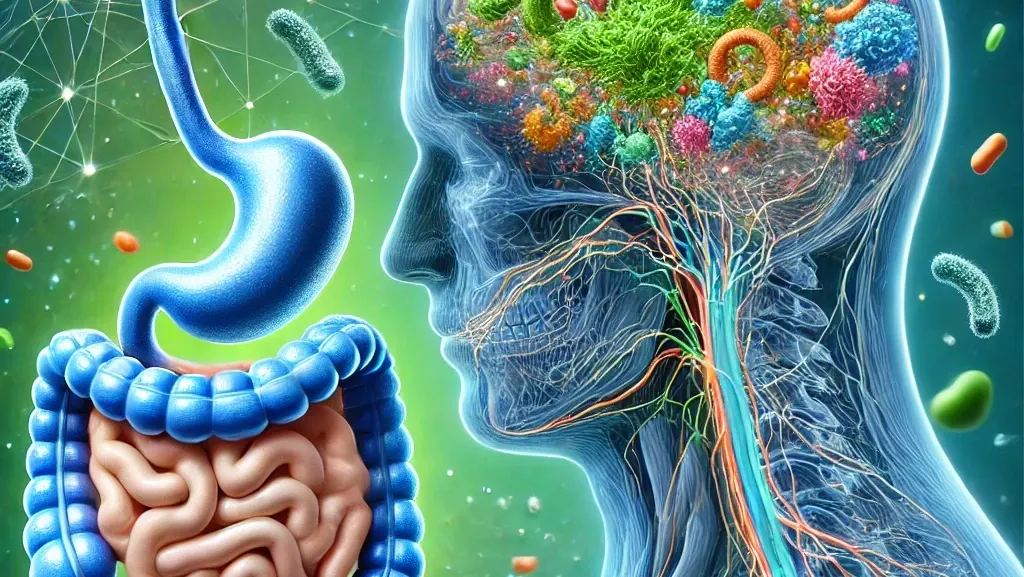
Have you ever made a decision based on a “gut feeling?” It turns out, that feeling is very real. The gut and the brain are in direct, continuous conversation through a network called the gut-brain axis — a bidirectional highway of neural, hormonal, and immune signals that runs between them. The primary physical pathway is the vagus nerve, which connects the brainstem to the digestive tract and carries information in both directions. Research has shown that the vast majority of that signaling — roughly 80 to 90 percent — travels from the gut up to the brain, not the other way around.
This means the gut is not just responding to the brain. It is informing the brain, constantly, about the state of the body. And what the gut is working with — the food you eat, and the microbial community that processes it — shapes the quality of those signals.
The gut houses what is sometimes called the “secondary brain,” an enteric nervous system that is made up of a network of approximately 500 million neurons lining the gastrointestinal tract. About 95 percent of the body’s serotonin — the neurotransmitter most associated with mood regulation, emotional stability, and a sense of wellbeing — is produced there, not in the brain. The health of those neurons, and their ability to produce and regulate serotonin, depends heavily on the trillions of microorganisms that make up the gut microbiome.
When the microbiome is diverse and well-nourished, it supports the production of neurotransmitters, keeps inflammation in check, and helps regulate the stress response. When it is depleted — by poor diet, chronic stress, antibiotics, or processed food — those functions degrade. Studies have found that people with less diverse gut microbiomes show higher rates of depression, anxiety, and cognitive difficulty. The relationship is not coincidental.
What Inflammation Does to a Leader
When the gut lining is compromised — a condition sometimes called intestinal permeability — bacterial byproducts can cross into the bloodstream and trigger an immune response. That immune response produces inflammatory cytokines, signaling molecules that circulate throughout the body and reach the brain. Elevated levels of inflammatory markers have been consistently associated with depression, cognitive slowing, reduced motivation, and emotional dysregulation.
For a leader, this can show up not as slower decision-making, difficulty accessing flexible, integrative thinking that complex problems require, a shorter fuse, and less capacity to hold ambiguity without anxiety.
The same dietary patterns that drive inflammation — high in refined carbohydrates, ultra-processed foods, and industrial seed oils, low in fiber and phytonutrients — are the ones most common in high-pressure professional environments where convenience and speed dominate food choices. The irony is that the eating patterns most likely to accompany a demanding career are often the ones most corrosive to the cognitive and emotional functions that career demands.
What the Research Points Toward
The dietary pattern with the strongest evidence base for mental health outcomes is the Mediterranean diet — rich in vegetables, legumes, whole grains, olive oil, fish, and fermented foods, and low in ultra-processed ingredients. A landmark randomized controlled trial published in 2017 found that dietary intervention along Mediterranean lines produced significant reductions in depression symptoms, with about a third of participants achieving full remission. A 2019 meta-analysis confirmed that higher adherence to Mediterranean eating patterns was associated with substantially lower risk of depression.
Now I don’t believe there is such a thing as eating perfectly or following a rigid protocol. Restriction and denial have a whole host of negative affects on the brain and behavior. Rather, I recommend understanding that the research points to patterns — more whole foods, more fiber, more variety, more fermented foods — rather than prescriptions. The gut microbiome responds to dietary change relatively quickly, and mood and cognitive effects can follow.
Where to Start
For leaders and anyone navigating high cognitive and emotional demand, a few shifts carry disproportionate weight:
Prioritize fiber diversity. The gut microbiome is fed primarily by plant fiber. Variety matters more than quantity — different plant foods feed different microbial species. Thirty different plant sources per week is a research-supported target that sounds more difficult than it is once you start counting. A large-scale study found that people eating more than 30 different plant foods weekly had significantly more diverse microbiomes than those eating fewer than 10.
Add fermented foods. Yogurt, kefir, kimchi, sauerkraut, miso — these introduce live microorganisms that support microbial diversity. A Stanford study published in 2021 found that a diet high in fermented foods increased microbiome diversity and reduced markers of inflammation over ten weeks.
Reduce ultra-processed food. This category — not junk food specifically, but industrially processed products with long ingredient lists — is consistently associated with poorer mental health outcomes across large population studies. One prospective study found a dose-dependent relationship between ultra-processed food consumption and depression risk.
Attend to omega-3 intake. Fatty fish, walnuts, and flaxseed provide omega-3 fatty acids that support neuronal membrane function and have demonstrated anti-inflammatory and mood-stabilizing effects in multiple clinical trials.
Minimize high-glycemic eating under stress. The instinct to reach for refined carbohydrates when under pressure is understandable — they produce a rapid glucose spike and a brief sense of relief. The crash that follows amplifies cortisol and emotional reactivity, which is the opposite of what sustained performance requires.
None of this replaces the structural and organizational work that burnout and mental health in the workplace genuinely require. It does add the biological layer that determines whether the psychological tools, therapy, mindfulness practice, and leadership coaching are founded upon a well-functioning system.